“What’s Love Got to Do With It” faculty seminar brought together faculty from varying departments together to explore how emotions (fear, anger, sadness, and love) shape both learning and liberation in the classroom. Co-created by Mengia Tschalär PhD (Anthropology and Law and Society) and Emese Ilyés, Ph.D., (Psychology), the seminar created a space where faculty could explore the emotional dimensions of teaching as central to the way that faculty show up in the classroom, and central to the work of critical pedagogy. At a time when faculty and students alike are navigating uncertainty, stress, and shifting institutional landscapes, this seminar created space to consider emotions not as peripheral, but as central to teaching, learning, and collective healing. Dr. Tschalär and Dr. Ilyés do not believe attending to emotions is an optional add on but is necessary for the work that must be done in the classroom as educators. Both facilitators bring different disciplinary lenses to this question, and they aimed to model the kind of interdisciplinary, emotion-based, embodied, vulnerable, community-centered learning they hope to see in classrooms.
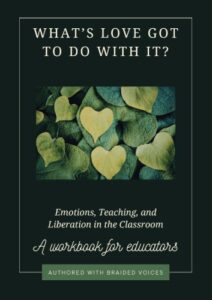
Love in this context draws from bell hooks’ understanding of love as a practice. Love is not a feeling we passively experience, but something we actively build in community. It is a choice. A verb. It also draws from Audre Lorde’s scholarship, helping us see love as a creative force that allows us to step into spaces of imagination, playfulness, risk-taking, and deep connection. Love in the context of the classroom is the courage to show up as whole people, to hold sacred what our bodies and emotions are telling us, and to build learning communities rooted in care, justice, and collective liberation.
Mengia Tschalär Ph.D., Emese Ilyés, Ph.D.
Faculty explored how emotions (fear, anger, sadness, and love) shape both learning and liberation in the classroom by weaving together insights from neuroscience, somatic practices, decolonial psychology, and critical pedagogy theorists such as bell hooks, Audre Lorde, and Frantz Fanon. They recognized how embodied experiences of togetherness in the classroom reflect broader socio-political realities and how emotional awareness can become a pathway toward educational transformation.
Across three modules and an integration session, the learning community engaged in deeply experiential work. It began with their very first time together when everyone brought and shared objects that represented their journeys. During this session faculty explored how emotions show up in the body through the lens of neuroscience and Frantz Fanon’s decolonial framework. In the second session, they brought the Community Resiliency Model (CRM) to the community. CRM is a set of somatic wellness skills such as tracking sensations, grounding, resourcing, and “Help Now” strategies. Together, participants explored how these tools could be adapted for classroom settings and for different contexts. The third session brought in Audre Lorde’s work and bell hooks’ framework of love, exploring how anger and love function as forces for transformation. Throughout, the community co-created a living workbook capturing collective insights, reflection prompts, and practical tools that any educator can integrate into their teaching. It was important for the facilitators to fold more people into the experience they had the privilege of accessing together by creating this workbook. The seminar culminated in each participant designing a 15-minute pedagogical intervention showing how they would bring these approaches into their own classrooms.
You can view the completed workbook here!
Key References
Lorde, A. (1984). The uses of anger: Women responding to racism. In Sister outsider: Essays and speeches. Crossing Press.
Lorde, A. (1984). Uses of the erotic: The erotic as power. In Sister outsider: Essays and speeches. Crossing Press.
hooks, b. (1994). Teaching to transgress: Education as the practice of freedom. Routledge.
Fanon, F. (2004). The wretched of the earth (R. Philcox, Trans.). Grove Press. (Original work published 1961)

